Introduction
Search engine optimization has evolved significantly. It’s no longer just about writing individual blog posts and waiting for them to rank. Many fast-growing websites now create thousands, even millions, of SEO pages automatically. This method is called Programmatic SEO.
If you’ve ever wondered how companies like Zapier, Airbnb, Wise, or Indeed dominate search results for a wide range of keywords, this guide will explain their approach and how you can apply the same technique responsibly and effectively.
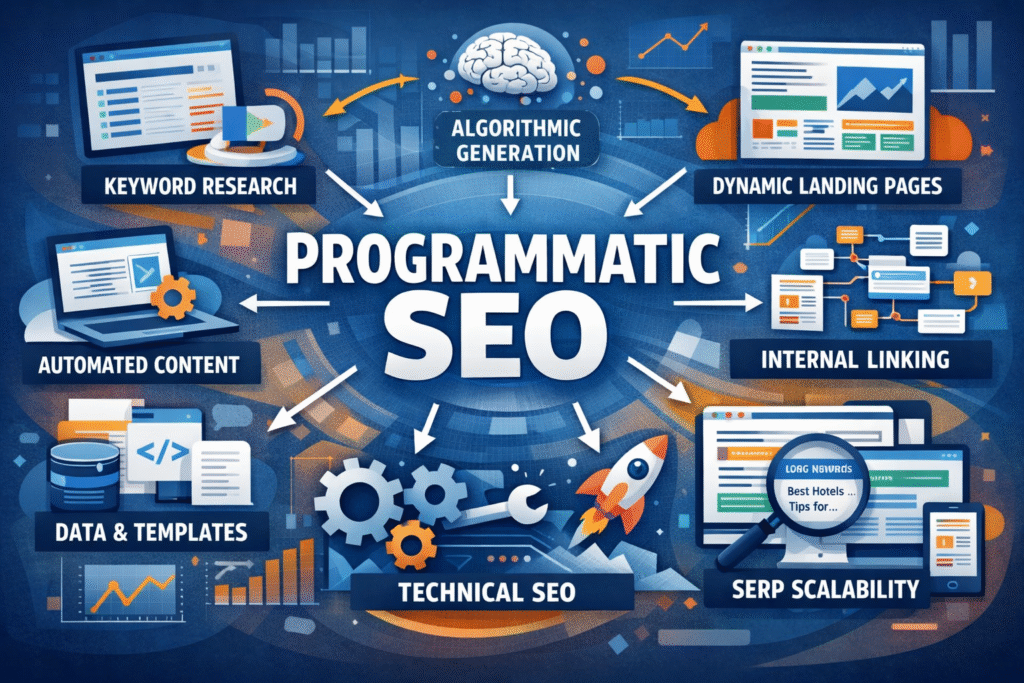
What Is Programmatic SEO?
- Programmatic SEO (pSEO) involves automatically creating many optimized web pages using templates, structured data, and established rules.
Instead of writing each page by hand, you:
– Identify a scalable keyword pattern
– Create a reusable page template
– Fill that template with data
– Generate hundreds or thousands of unique pages
Each page focuses on a specific long-tail keyword while keeping a similar structure.
Simple Example
Instead of writing one article titled:
“Best digital marketing agencies in India,”
Programmatic SEO allows you to generate:
Best digital marketing agencies in Mumbai
Best digital marketing agencies in Bangalore
Best digital marketing agencies in Delhi
Best digital marketing agencies in Chennai
One template combined with a city database can lead to hundreds of SEO pages.
Why Programmatic SEO Works So Well
Programmatic SEO is effective because it aligns with how people usually search online.
Most searches are long-tail queries, which are specific, low-competition, and driven by intent. While each query may attract low traffic by itself, together they represent a significant opportunity.
Key Benefits of Programmatic SEO
– Scalability: Rank for thousands of keywords simultaneously.
– Lower competition: Long-tail keywords are easier to rank for.
– High intent traffic: Users often convert better.
– Cost efficiency: Lower content creation costs at scale.
– Easy optimization: Update templates instead of individual pages.
When done correctly, programmatic SEO can be a powerful source of traffic.
It’s important to recognize that programmatic SEO does not replace traditional SEO. The best websites effectively use both strategies.
When Should You Use Programmatic SEO?
Programmatic SEO works best under certain conditions.
Consider using programmatic SEO if:
Programmatic SEO vs. Traditional SEO
Traditional SEO | Programmatic SEO
Manual content creation | Automated content generation
One page at a time | Hundreds or thousands of pages
Blog-focused | Data-focused
Slower scaling | Rapid scaling
High writing effort | High planning effort
– Your niche has repeatable keyword patterns.
– You have access to structured or semi-structured data.
– Each keyword variation needs its own page.
– Users expect similar information across variations.
Industries That Benefit Most
– SaaS products
– Marketplaces
– Travel and hospitality
– Job portals
– Real estate platforms
– Finance and fintech
– E-commerce directories
– Educational platforms
If your website organizes information by location, category, price, feature, or comparison, programmatic SEO may be a good fit.
How Programmatic SEO Works: Step-by-Step
Step 1: Identify Scalable Keyword Patterns
The foundation of programmatic SEO is keyword patterns, not individual keywords.
Common patterns include:
– [service] in [location]
– best [tool] for [use case]
– [product] alternatives
– [job role] salary in [city]
– [software] integrations with [tool]
Use tools like:
– Ahrefs
– SEMrush
– Google Keyword Planner
– Google auto-complete
– “People Also Ask”
Your goal is to find keywords that can repeat with different variables.
Step 2: Analyze Search Intent
Not every keyword pattern suits programmatic SEO.
Ask yourself:
– Does this keyword deserve its own page?
– Would users expect unique information here?
– Can I provide value beyond what’s already available?
For example:
❌ “Time in city X” (Google already answers this)
✅ “Best coworking spaces in city X” (requires detailed information)
Validating search intent is essential to avoid creating low-quality pages.
Step 3: Gather and Structure Data
Data sets programmatic SEO apart from spam.
Your pages must rely on accurate and useful data, such as:
– Prices
– Ratings
– Features
– Locations
– Comparisons
– Statistics
Common Data Sources
– Internal company databases
– Public datasets
– APIs
– Ethical web scraping
– User-generated content
– Surveys and research
The quality of your data directly impacts your rankings.
Step 4: Design SEO Page Templates
Templates provide the framework for each programmatic page.
A strong template should include:
– SEO-friendly title tags
– H1, H2, and H3 structure
– Dynamic intro text
– Data tables or lists
– FAQs
– Internal links
– Call-to-action sections
Example Title Formula
Best {{Service}} in {{City}} (Updated 2025)
Templates need to strike a balance between automation and natural language to avoid sounding robotic.
Step 5: Generate Pages Programmatically
Once the template and data are prepared, you can create pages using various tools and frameworks.
Common Tech Stacks
– Next.js or React
– Gatsby or Astro
– WordPress with custom scripts
– Webflow CMS
– Python plus static site generators
Each row in your database becomes one unique URL.
Step 6: Optimize On-Page SEO at Scale
Every programmatic page must follow SEO best practices:
– Unique title and meta description
– Clean, readable URLs
– Optimized headings
– Internal linking
– Schema markup (FAQ, Product, Review, etc.)
– Fast page speed
– Mobile-friendly design
Automation should not compromise SEO basics.
Step 7: Build Internal Linking Systems
Internal linking is crucial for large-scale SEO.
Effective methods include:
– Breadcrumb navigation
– Category and subcategory pages
– “Related pages” sections
– Location or feature clusters
Strong internal linking helps:
– Search engines navigate your site smoothly
– Distribute authority across pages
– Boost rankings for deeper pages
Real-World Programmatic SEO Examples
Zapier
Zapier creates pages for software integrations, including:
“Apps that integrate with Slack”
“Slack integrations with CRM tools”
These pages are data-driven and genuinely useful.
Airbnb
Airbnb ranks for many location-based searches using templated city and neighborhood pages along with user-generated content.
Wise
Wise uses programmatic pages for currency conversion, international fees, and country-specific finance queries.
These companies show that programmatic SEO works well when quality is prioritized.
Common Programmatic SEO Mistakes
1. Thin or Duplicate Content
Automatically generated content without real value can get deindexed.
2. Indexing Too Many Pages
Not every page should be indexed. Use:
– noindex tags
– Canonical URLs
– Pagination controls
3. Ignoring User Experience
SEO pages must remain readable, fast, and helpful.
4. No Content Maintenance
Outdated data can hurt rankings and trust.
Programmatic SEO and Google Guidelines
Google does not punish automation.
Google penalizes:
– Scaled spam
– Thin affiliate pages
– Duplicate or low-value content
As long as your pages are:
– Helpful
– Original
– Data-backed
– User-focused
Programmatic SEO fully complies with Google’s guidelines.
Tools for Programmatic SEO
Keyword Research
– Ahrefs
– SEMrush
– Google Search Console
Data Management
– Google Sheets
– Airtable
– Python
– APIs
Technical SEO
– Screaming Frog
– Sitebulb
– PageSpeed Insights
Content & CMS
– Next.js
– WordPress
– Webflow
– Headless CMS platforms
Is Programmatic SEO Worth It in 2025?
Yes, but only when done right.
Programmatic SEO requires:
– Strong planning
– High-quality data
– SEO expertise
– Long-term commitment
When executed well, it can be one of the most effective strategies for organic growth with high ROI.
Final Thoughts
Programmatic SEO is not about shortcuts or tricking search engines. It focuses on systematically addressing search intent on a large scale.
Search engine optimization has evolved significantly. It’s no longer just about writing individual blog posts and waiting for them to rank. Many fast-growing websites now create thousands, even millions, of SEO pages automatically. This method is called Programmatic SEO.
If you’ve ever wondered how companies like Zapier, Airbnb, Wise, or Indeed dominate search results for a wide range of keywords, this guide will explain their approach and how you can apply the same technique responsibly and effectively.
What Is Programmatic SEO?
Programmatic SEO (pSEO) involves automatically creating many optimized web pages using templates, structured data, and established rules.
Instead of writing each page by hand, you:
– Identify a scalable keyword pattern
– Create a reusable page template
– Fill that template with data
– Generate hundreds or thousands of unique pages
Each page focuses on a specific long-tail keyword while keeping a similar structure.
Simple Example
Instead of writing one article titled:
“Best digital marketing agencies in India,”
Programmatic SEO allows you to generate:
Best digital marketing agencies in Mumbai
Best digital marketing agencies in Bangalore
Best digital marketing agencies in Delhi
Best digital marketing agencies in Chennai
One template combined with a city database can lead to hundreds of SEO pages.
Why Programmatic SEO Works So Well
Programmatic SEO is effective because it aligns with how people usually search online.
Most searches are long-tail queries, which are specific, low-competition, and driven by intent. While each query may attract low traffic by itself, together they represent a significant opportunity.
Key Benefits of Programmatic SEO
– Scalability: Rank for thousands of keywords simultaneously.
– Lower competition: Long-tail keywords are easier to rank for.
– High intent traffic: Users often convert better.
– Cost efficiency: Lower content creation costs at scale.
– Easy optimization: Update templates instead of individual pages.
When done correctly, programmatic SEO can be a powerful source of traffic.
Programmatic SEO vs. Traditional SEO
Traditional SEO | Programmatic SEO
Manual content creation | Automated content generation
One page at a time | Hundreds or thousands of pages
Blog-focused | Data-focused
Slower scaling | Rapid scaling
High writing effort | High planning effort
It’s important to recognize that programmatic SEO does not replace traditional SEO. The best websites effectively use both strategies.
When Should You Use Programmatic SEO?
Programmatic SEO works best under certain conditions.
Consider using programmatic SEO if:
– Your niche has repeatable keyword patterns.
– You have access to structured or semi-structured data.
– Each keyword variation needs its own page.
– Users expect similar information across variations.
Industries That Benefit Most
– SaaS products
– Marketplaces
– Travel and hospitality
– Job portals
– Real estate platforms
– Finance and fintech
– E-commerce directories
– Educational platforms
If your website organizes information by location, category, price, feature, or comparison, programmatic SEO may be a good fit.
How Programmatic SEO Works: Step-by-Step
Step 1: Identify Scalable Keyword Patterns
The foundation of programmatic SEO is keyword patterns, not individual keywords.
Common patterns include:
– [service] in [location]
– best [tool] for [use case]
– [product] alternatives
– [job role] salary in [city]
– [software] integrations with [tool]
Use tools like:
– Ahrefs
– SEMrush
– Google Keyword Planner
– Google auto-complete
– “People Also Ask”
Your goal is to find keywords that can repeat with different variables.
Step 2: Analyze Search Intent
Not every keyword pattern suits programmatic SEO.
Ask yourself:
– Does this keyword deserve its own page?
– Would users expect unique information here?
– Can I provide value beyond what’s already available?
For example:
❌ “Time in city X” (Google already answers this)
✅ “Best coworking spaces in city X” (requires detailed information)
Validating search intent is essential to avoid creating low-quality pages.
Step 3: Gather and Structure Data
Data sets programmatic SEO apart from spam.
Your pages must rely on accurate and useful data, such as:
– Prices
– Ratings
– Features
– Locations
– Comparisons
– Statistics
Common Data Sources
– Internal company databases
– Public datasets
– APIs
– Ethical web scraping
– User-generated content
– Surveys and research
The quality of your data directly impacts your rankings.
Step 4: Design SEO Page Templates
Templates provide the framework for each programmatic page.
A strong template should include:
– SEO-friendly title tags
– H1, H2, and H3 structure
– Dynamic intro text
– Data tables or lists
– FAQs
– Internal links
– Call-to-action sections
Example Title Formula
Best {{Service}} in {{City}} (Updated 2025)
Templates need to strike a balance between automation and natural language to avoid sounding robotic.
Step 5: Generate Pages Programmatically
Once the template and data are prepared, you can create pages using various tools and frameworks.
Common Tech Stacks
– Next.js or React
– Gatsby or Astro
– WordPress with custom scripts
– Webflow CMS
– Python plus static site generators
Each row in your database becomes one unique URL.
Step 6: Optimize On-Page SEO at Scale
Every programmatic page must follow SEO best practices:
– Unique title and meta description
– Clean, readable URLs
– Optimized headings
– Internal linking
– Schema markup (FAQ, Product, Review, etc.)
– Fast page speed
– Mobile-friendly design
Automation should not compromise SEO basics.
Step 7: Build Internal Linking Systems
Internal linking is crucial for large-scale SEO.
Effective methods include:
– Breadcrumb navigation
– Category and subcategory pages
– “Related pages” sections
– Location or feature clusters
Strong internal linking helps:
– Search engines navigate your site smoothly
– Distribute authority across pages
– Boost rankings for deeper pages
Real-World Programmatic SEO Examples
Zapier
Zapier creates pages for software integrations, including:
“Apps that integrate with Slack”
“Slack integrations with CRM tools”
These pages are data-driven and genuinely useful.
Airbnb
Airbnb ranks for many location-based searches using templated city and neighborhood pages along with user-generated content.
Wise
Wise uses programmatic pages for currency conversion, international fees, and country-specific finance queries.
These companies show that programmatic SEO works well when quality is prioritized.
Common Programmatic SEO Mistakes
1. Thin or Duplicate Content
Automatically generated content without real value can get deindexed.
2. Indexing Too Many Pages
Not every page should be indexed. Use:
– noindex tags
– Canonical URLs
– Pagination controls
3. Ignoring User Experience
SEO pages must remain readable, fast, and helpful.
4. No Content Maintenance
Outdated data can hurt rankings and trust.
Programmatic SEO and Google Guidelines
Google does not punish automation.
Google penalizes:
– Scaled spam
– Thin affiliate pages
– Duplicate or low-value content
As long as your pages are:
– Helpful
– Original
– Data-backed
– User-focused
Programmatic SEO fully complies with Google’s guidelines.
Tools for Programmatic SEO
Keyword Research
– Ahrefs
– SEMrush
– Google Search Console
Data Management
– Google Sheets
– Airtable
– Python
– APIs
Technical SEO
– Screaming Frog
– Sitebulb
– PageSpeed Insights
Content & CMS
– Next.js
– WordPress
– Webflow
– Headless CMS platforms
Is Programmatic SEO Worth It in 2025?
Yes, but only when done right.
Programmatic SEO requires:
– Strong planning
– High-quality data
– SEO expertise
– Long-term commitment
When executed well, it can be one of the most effective strategies for organic growth with high ROI.
Final Thoughts
Programmatic SEO is not about shortcuts or tricking search engines. It focuses on systematically addressing search intent on a large scale.